






Creating Something Lasting
John Morris discusses rebuilding his creative career through Morvelis, bringing art, music and writing together while navigating ongoing illness, protecting quality and building a business grounded in lasting human relationships.
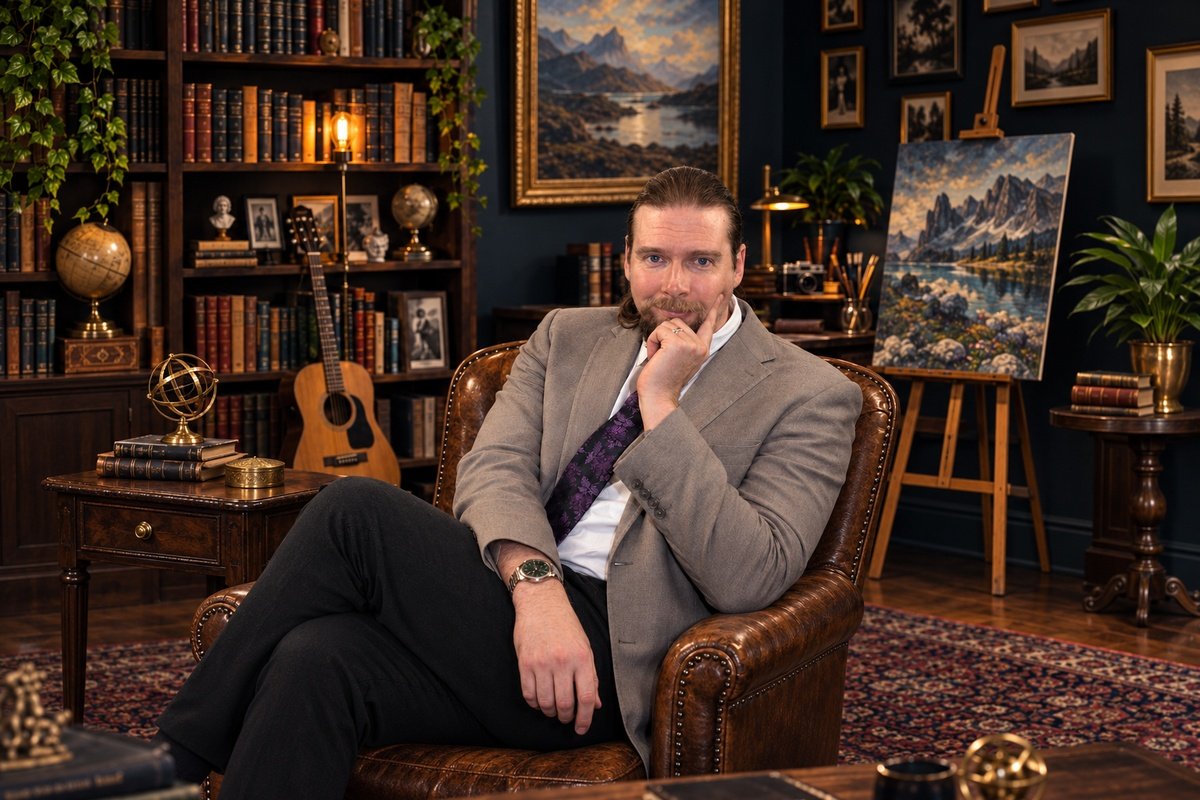
Some businesses begin with a clear plan. For John Morris, the path from painting as a teenager to founding Morvelis has been shaped by gradual discoveries, overlapping creative interests and an enduring concern for the people encountering his work.
The Scottish artist, author and creative entrepreneur is bringing fine art, music, literature, clothing and mentoring together under one identity. His guiding phrase, ‘Creating lasting art in an age of discard’, describes an ambition that extends from the quality of a finished work to the attention a customer receives.
In this exclusive interview with Entrepreneur Prime, Morris reflects on the lessons of youth ministry, the discipline of choosing projects while managing ongoing health challenges, and why a creative business must learn to build relationships as carefully as it develops its products. He also discusses the phoenix that became Morvelis’s mascot, the company’s planned December launch and the evidence of meaningful growth he hopes to see over the coming years.
You began painting because you wanted to bring the images in your imagination to life. When did you first realise you could make a living from it?
I was around 17 when I first started painting seriously. I remember watching Bob Ross painting in the attic at my parents’ house. There was something about seeing an image emerge from a blank canvas that captured my imagination.
I worked one summer at a place in Holmfirth, and someone connected with the café at the front of the premises became aware of my artwork. I painted something for her. It wasn’t a particularly brilliant painting, if I’m being honest, but it was one of those early moments when somebody was willing to pay for something I’d created.
Later, through the internet and online chat rooms, including a Christian chat room, I sold another painting for perhaps £12 or £14. I still remember the customer’s name.
There wasn’t some grand business plan or sudden moment of revelation. It developed gradually. I was creating images that existed in my imagination, discovering that other people connected with them, and learning that there was a market for what I was doing. One opportunity led to another.
Before pursuing art full-time in 2016, you spent years in youth ministry in England and Scotland. What did that work teach you that you later brought to your art school, Art From the Heart?
I would slightly challenge the idea that these were separate chapters of my life. Art, business and youth ministry developed alongside one another. They were all happening simultaneously in different ways.
Youth ministry taught me a great deal about people. Humour was important. Sarcasm, having a laugh, being able to talk openly and, above all, listening. I always felt that if you wanted young people to open up, you had to approach them as human beings. You couldn’t simply walk into a room and try to indoctrinate them with what you thought they should believe.
In many respects, I saw the role as being something like a big brother. You had to build trust, understand the individual and give people room to talk.
I had more than a decade of genuinely happy experiences working with young people. I think those years reinforced something that has followed me into everything I’ve done since: people respond to being treated as people. They want to be heard, understood and respected.
That understanding has been invaluable, whether working with young artists, clients, colleagues or audiences.
You kept writing and developing ideas through a period of serious illness, when even small tasks could take weeks. How have your ongoing health challenges changed the way you work and decide which projects to take on?
They have changed absolutely everything, including the way I approach work.
I have always been somebody with an enormous number of ideas, but I have had to become much more selective about where I put my time and energy. These days, I tend to assess a project against three questions.
Is it something I’m passionate about? Is it going to make money? And do I genuinely want to do it, or will it move the business forward?
If a project doesn’t meet any of those criteria, I have to question why I’m taking it on.
That doesn’t mean I’ve stopped being ambitious or that I don’t enjoy hard work. I can still have extraordinarily productive days, sometimes starting at three or four in the morning and working into the evening. But that isn’t every day, and looking after myself has become part of the equation.
The biggest lesson has been that being busy and being productive are not necessarily the same thing. I would rather put my resources into something meaningful, worthwhile and properly developed than spread myself so thinly that nothing receives the attention it deserves.
A phoenix was the first image you created for what became Morvelis. What did it mean to you at the time, and how did that image develop into a business?
The phoenix had actually been part of my creative thinking for perhaps five to ten years before Morvelis became a business. There had been several logos and different ideas along the way. In many respects, it became the unofficial mascot of Morvelis.
The symbolism is fairly obvious, but that doesn’t make it any less meaningful: rising from the ashes, returning from something that should have finished you.
There was a point when I genuinely had to rethink everything. Without a significant change in circumstances, there might not have been another chapter. There would have been no Morvelis, no developing book projects, no new music and no continuation of the creative work I had spent so much of my life building.
I had to reconsider what I was capable of doing and how I could do it. Even the concert I had imagined producing required substantial adaptation. Musical arrangements, performance capabilities, technology and other people all became part of finding a way forward.
There were moments when the production looked as though it might never happen. I remember leaving the studio on my hands and knees and lying on the floor. It was an extraordinarily difficult period.
But I didn’t want Art From the Heart to be the final chapter of my story. I wanted to come back and create something special, something with a sense of scale, ambition and permanence. Morvelis grew out of that desire.
The phoenix wasn’t simply a logo. It represented the idea that the story wasn’t finished.
Morvelis brings together fine art, music, literature, clothing and mentoring. How do you decide which ideas belong under one roof and which to develop first?
Everything has to fit Morvelis. It has to make sense psychologically, creatively and in terms of the wider philosophy. If an idea doesn’t belong, we don’t pursue it simply because it might be commercially attractive.
I’ve spent years developing and refining my niche, and that has helped me understand what belongs within the company.
The projects are organised into a pipeline. I know what I’m working on now, what comes next and what may be developed further into next year and beyond. Having that structure is important because it allows me to be ambitious without trying to do everything simultaneously.
The connecting philosophy is the relationship between creativity, psychology and the human experience.
Think about how our surroundings affect us. The artwork and colours in a room can influence how we feel. A book can give us an entirely different perspective on our lives. Music can change the atmosphere of a moment, bring back memories or make us reflect on something we hadn’t considered before.
These things are not isolated from one another. They are different ways of engaging with the same human experience.
Morvelis is about creating lasting art, music and meaningful experiences. I want people to encounter something that makes them think, feel, smile, reflect or perhaps see the world a little differently.
Your guiding phrase is ‘Creating lasting art in an age of discard’. Can you give an example of a decision you’ve made at Morvelis because of that principle?
For me, quality is a given. The materials, production standards and finished work all have to meet the expectations I set for the company. But the principle goes much further than the physical product.
It also influences how we treat people.
Customer service, for example, should be something genuinely valuable. If somebody comes to Morvelis, they should receive time, attention, guidance and proper support. They’re not simply another transaction. They’re a person with an interest in something we’ve created.
I’ve spent more than 20 years working with clients, and that experience has taught me the importance of being accessible, approachable and genuinely helpful.
I sometimes look at the wider market and question why we have become so comfortable with things that are designed to have such a short shelf life. Is it deliberate? Is it simply about making money quickly? Or have we stopped expecting ourselves to create something better?
If you have the ability to make something meaningful, distinctive and lasting, why wouldn’t you?
Luxury isn’t simply about a price tag. It is about quality, attention, care and the experience surrounding something. I want Morvelis to reflect those values.
You’ve said you want your work to help people feel less alone. How have your psychology studies and mentoring experience shaped the way you explore loneliness and connection in your writing?
I think creativity is fundamental to being human. It isn’t something reserved for professional artists, musicians or writers. We all have the capacity to create, communicate and connect with other people.
I can’t physically be present with every person on the planet. Nobody can. But I can create something that becomes part of somebody else’s life. That might be a video, an audiobook, a book, a painting, a piece of music or something else entirely.
Through those things, I hope to spread a little light in a world where people are struggling.
I’ve spent nearly four decades learning, observing, questioning and experiencing life. I’ve studied psychology, philosophy and theology, and my ongoing psychology studies continue to influence how I think about identity, behaviour, suffering and the ways people make sense of their experiences.
My mentoring experience has also taught me that people don’t necessarily need somebody to arrive with all the answers. Sometimes they need somebody who listens, understands and gives them the space to work things out.
When I write, I want people to laugh at the things that made me laugh and cry at the things that made me cry. I want them to find their own reasons to laugh and cry in the stories. I want somebody to listen to a song and perhaps sob their heart out, then listen to another and find themselves tapping their feet. I want somebody to look at a painting every day for 20 years and still discover something new in it.
Ultimately, I want people to feel that there is somebody rooting for them. I might never meet them, but I hope they feel that connection through the work.
That’s the crux of it. I want people to know they’re not alone.
For the two-night Morvelis launch on 11 and 12 December, you’re bringing together music, visual art and storytelling. Which moment in the production are you most looking forward to sharing with audiences, and why?
All of it. All of it.
I genuinely cannot wait for people to see what we’ve put together. I hope and pray they love it. It represents the very best of Morvelis, right here and right now, with the resources we have and the people we are.
It’s difficult to explain just how much it means to me. There is something quite enormous and emotional about bringing all these different creative elements together and finally being able to share them.
If I had to choose a particular moment, it would probably be the finish. When everything is over, both nights have happened, the audience has experienced what we wanted them to experience, and we can look back and say we’ve done it.
Of course, there are all the practical things that have to come together. The streams, the transmission, the production and everything that happens behind the scenes. But ultimately, I want people to experience something absolutely incredible.
Everything that is meant to happen on night one and night two is meant to happen. And whatever happens, I want to be able to look back knowing we gave it everything.
As you build Morvelis for an international audience, what would make you feel, three years from now, that the company had grown in the way you hoped?
Evidence.
That’s the word I keep coming back to. I want evidence that Morvelis has become what we set out to make it.
By November 2029, I would love to see a significant impact from our children’s television projects, and to have become a hugely successful author across adult fiction, children’s fiction and nonfiction. I would also like to have achieved, or be very close to achieving, a master’s degree if that remains the right direction for my studies.
More than anything, I want Morvelis and the people working within it to be recognised for having created something phenomenal. Something that has made a difference. Something that has been a light in the darkness for people around the world.
Financial independence is important too. Not simply for its own sake, but because a successful business creates the resources to fund further creativity, employ people, develop ideas and reach more audiences.
There is something I am particularly conscious of, though. I don’t want Morvelis to become a delusion or a deception of what we originally set out to achieve. I don’t want the identity of the company to disappear beneath the pressure to grow.
Ambition is important, but so are discipline, structure and knowing who you are. I want the company to become bigger without losing the reasons it exists in the first place.
Drawing on more than 20 years in the creative industries, what advice would you give an artist or writer who wants to turn their creative practice into a sustainable business?
Learn marketing. Learn sales. Learn how to talk to people and communicate with them.
Marketing is nothing more than show and tell. Sales happen as a result of the work you do through that show and tell. It really is unbelievably simple. Don’t overcomplicate it.
People don’t want to be sold to. They want relationships built with them. If somebody sees you constantly trying to sell them something, you will struggle. But if you show them what you’re doing, take them along on the journey and approach them as a genuine human being, they will respond differently.
Remember one thing, if nothing else: behind every successful sale is a human being. Somebody with thoughts, feelings, emotions, a personality, cares and worries. Be concerned about that person. It will serve you incredibly well.
One of the biggest misunderstandings I see is that some creative people don’t realise that the moment they start selling their work, they’re in business. Others believe they can put enormous amounts of substandard work onto the open market and somehow expect people to buy it. Some fail to understand the importance of honest conversations, even when those conversations don’t immediately result in a sale.
You’re building a relationship.
I’ve watched countless companies, businesses and solo entrepreneurs come and go over the past 20 years. Some had decent products, some had terrible products, but many made the same mistake: they became so focused on selling that they forgot about the people they were selling to.
I’ve also seen people set themselves so far apart from everybody else that they destroy their own opportunities. I don’t believe business has to be an endless competition in which somebody else must lose for you to win.
When I go onto somebody else’s podcast, television programme, radio show or magazine, I want to bring as many people along with me as possible. I want to give that platform the very best interview I can. I want the people involved to benefit from having me there, just as I benefit from having somewhere to share my stories.
It works hand in hand. You can have the greatest story in the world, but if you have nobody to share it with, nobody is listening and nobody is buying. You can create extraordinary music, but if you haven’t built relationships with people who will play it, it won’t reach an audience. The same applies to art. You can create something remarkable, but if you have nowhere to exhibit it, people may never see it.
And I would say the same to anybody who has already achieved a significant level of success: reach back and help somebody who is still trying to make it. Help the smaller business, the emerging artist, the person who is struggling to find their feet.
One day, you might want to have a phenomenal conversation about something, and that person could be the only person in the world with whom you can have it. But if you never helped them when they needed it, they might no longer be there.
I’ve seen that happen.
If you win, somebody else can win too. It doesn’t need to be competition. Wherever possible, elevate other people.
And try not to be an idiot to somebody on the way up. You never know who you might need on the way down.
Public life is something I take incredibly seriously. You have to remain conscious of what you’re doing, what you’re saying and who you’re saying it to. That responsibility is not always easy, but it matters.
Ultimately, a sustainable creative business isn’t built on the product alone. It’s built on the quality of the work, the relationships around it and the people who make it possible to keep creating.