










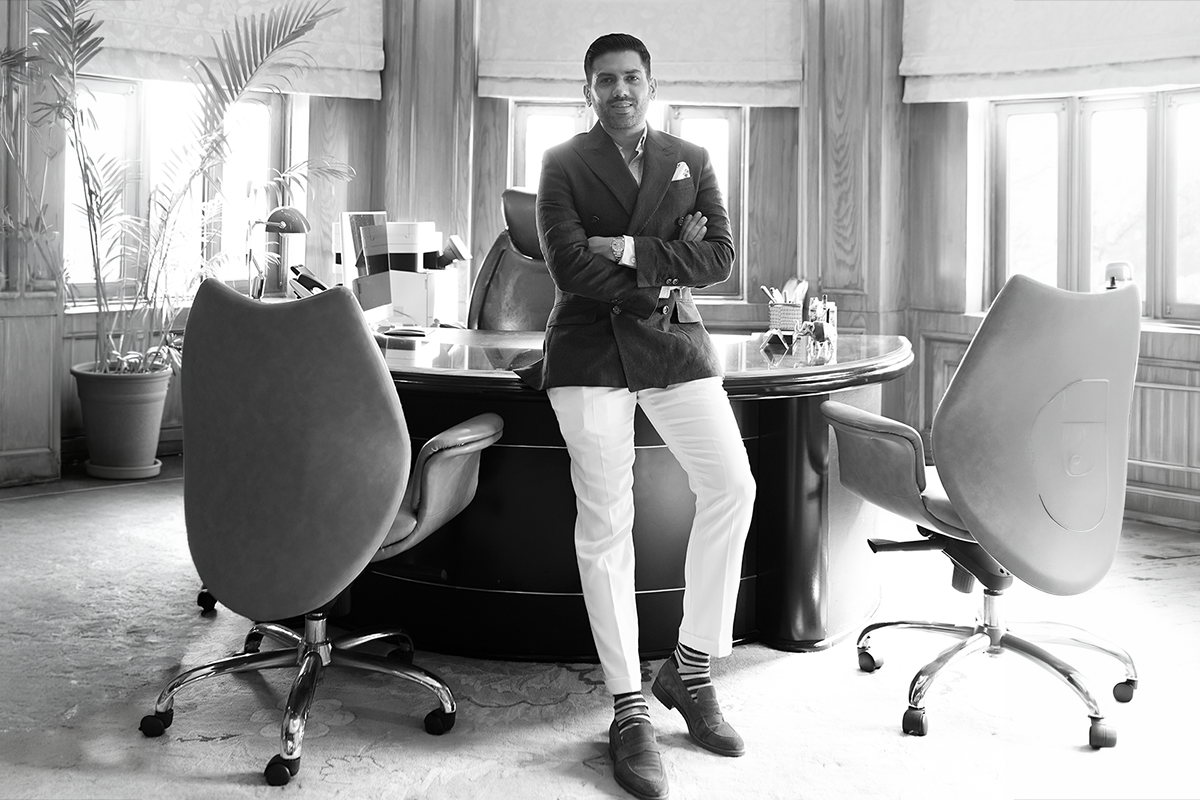
Photo: Roop Partap Choudhary, founder of Colonel Saab, brings his family’s journeys across India to London through food, art and a deeply personal approach to hospitality.
Roop Partap Choudhary discusses building Colonel Saab through family heritage, Indian cuisine and personal storytelling, while protecting quality, empowering teams, supporting communities and pursuing thoughtful growth across his hospitality businesses.
O ur interview was arranged for six o’clock on a Wednesday evening at Colonel Saab in Trafalgar Square. I arrived an hour early. Before meeting the man behind the restaurant, I wanted to understand the place he had chosen for it.
In business, an address tells a story before anyone opens the door.
A short walk from Trafalgar Square and the Strand, Colonel Saab sits amid the energy of central London: theatres, visitors, offices and people heading out for the evening. The Strand has always reminded me of New York’s Broadway. As a student, I loved spending time around Broadway, although my budget often led me towards the more affordable Off-Broadway productions. Those memories returned as I walked through London’s theatre district, watching a neighbourhood prepare for another evening’s performances.
It was a fitting introduction to a conversation about hospitality. A restaurant belongs to its surroundings, and a thoughtful entrepreneur understands the relationship between the two.
We see the importance of location in the simplest purchases. A bottle of water bought cheaply in a neighbourhood shop can command several pounds in an airport or a luxury department store. The contents may be much the same, but convenience, setting and expectations change its perceived value. For a restaurant, the challenge is greater: the food, service and atmosphere must fulfil the promise made by the address.
Three things about Colonel Saab particularly caught my attention.
The first was the name. Colonel Saab is distinctive, memorable and unmistakably connected to India, yet it travels comfortably across cultures. There is dignity in it, but also affection. As our interview reveals, that affection is personal: the restaurant is a tribute to Roop’s father, Colonel Manbeer Choudhary, and to the family journeys that shaped his understanding of India.
The second was the development of two London restaurants, in Holborn and Trafalgar Square, within the brand’s first five years. Establishing a presence in either location is a considerable undertaking. Building a recognisable identity across both speaks to ambition, judgement and the ability to turn an idea into a working business.
The third was the depth behind that idea. Roop has brought together food, art, family photographs and objects gathered through a life of travel. These details give Colonel Saab its personality. They invite guests to discover the people and memories behind the restaurant, while the emphasis on Indian home cooking gives that story its most direct expression.
What I admire about Roop is his understanding that hospitality depends on people. Throughout our conversation, he returns to the importance of his parents, his colleagues and his guests. He speaks about protecting ingredients, giving his teams room to exercise judgement and expanding only when standards can be maintained. These are practical convictions with consequences for the business.
For Entrepreneur Prime, that makes him a compelling cover personality. His story brings together family enterprise, cultural confidence and the discipline required to build a hospitality brand in a demanding city.
I arrived early to explore a location. Our conversation took me much further: into the experiences, relationships and decisions that give a business its character.
Roop Partap Choudhary combines entrepreneurial vision, cultural pride and thoughtful leadership, creating distinctive hospitality experiences rooted in heritage and care.
Growing up in a hospitality family, what did you learn from your parents that still guides you, and where have you chosen a different entrepreneurial path?
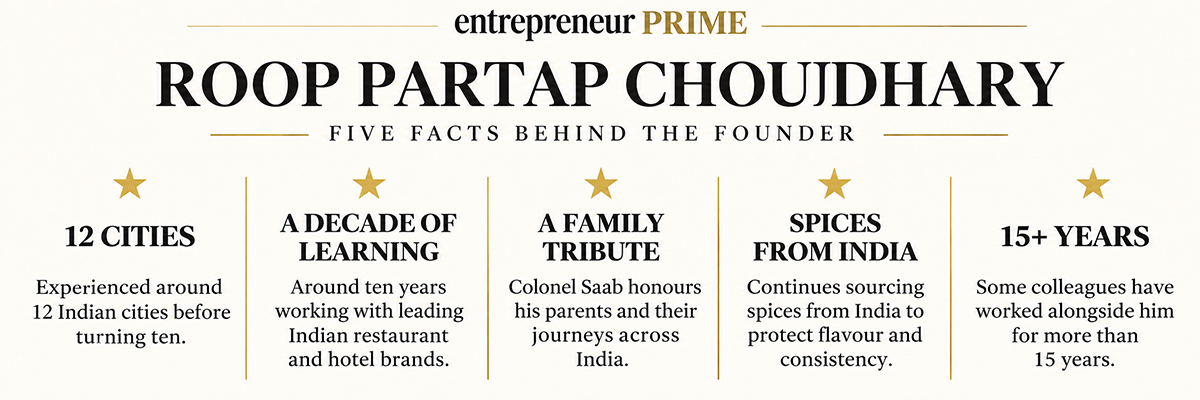
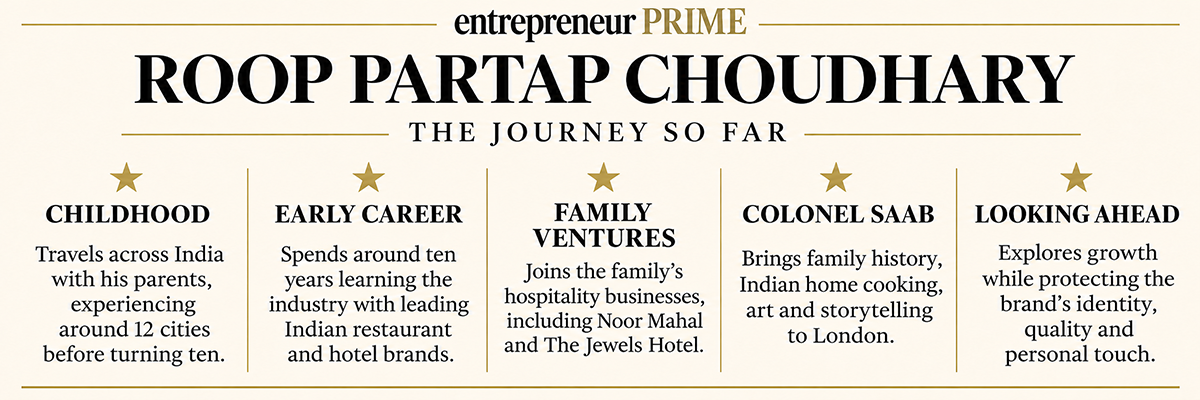
My upbringing was shaped by both my parents, Colonel Manbeer Choudhary and Mrs Binny Choudhary. My father served in the Indian Army, and because of his postings, we moved across different cities and experienced different parts of India. I had experienced around 12 cities before I turned ten. My mother played an equally important role in making each new place feel like home and keeping us connected to our family values and traditions.
Those years gave me an early understanding of India’s diversity, its people, food, cultures and ways of life. My own professional journey in hospitality developed over time. I spent approximately ten years working with some of India’s leading restaurants and hotel brands. That experience allowed me to understand the industry from the ground up, learn from established businesses and develop my own approach to hospitality.
My journey later brought me into the family’s hospitality ventures, including Noor Mahal and The Jewels Hotel. I have always believed in building on the values and experiences I grew up with while bringing my own ideas and entrepreneurial perspective to the businesses. My interests in food, art, literature and storytelling have also played an important role in the brands I have developed.
Highlights
- Childhood travels across India shaped his understanding of regional food, culture and hospitality.
- Colonel Saab honours his father’s Army career and his mother’s role in preserving family traditions.
- North Indian home cooking guides his approach to the menu.
- Family photographs, letters and artefacts give the restaurants their personal identity.
- He continues sourcing spices from India to protect flavour and consistency.
- Some colleagues have worked with him for more than 15 years.
- His approach to wellness includes thoughtful service, good food and human connection.
- Expansion depends on preserving quality, standards and the brand’s character.
Colonel Saab draws on your family’s travels across India. Which personal memory best captures its spirit, and how have you translated it into the guest experience?
My childhood was shaped by travelling across India with my family as my father served in the Army. Every posting introduced us to a different city, culture, cuisine and way of life. My mother was an important part of those experiences too. While my father’s postings took us across the country, she helped make each place feel like home and ensured that our family traditions travelled with us.
“I wanted the restaurant to feel personal rather than lıke a themed space.”
Colonel Saab is, in many ways, a love letter to my father and a tribute to my parents and the life they shared with us. It celebrates his journeys and the experiences that shaped our family, as well as the memories and values my mother helped preserve.
I wanted to create a place in London that carried those memories and allowed people to discover a little more about India through them. The photographs, paintings, memorabilia, artefacts and food all have stories behind them. I wanted the restaurant to feel personal rather than like a themed space. It should feel as though guests are being welcomed into a home where every object has a memory attached to it.
For me, the most meaningful part is being able to share something so personal with people from different backgrounds and cultures.
Which regional Indian dish or culinary tradition deserves greater recognition in Britain, and how would you introduce it to someone encountering it for the first time?
I have predominantly been exposed to North Indian cuisine, and its beauty lies in the many influences that have shaped it. Persian and Afghan influences, among others, have helped create a cuisine that is much broader and more varied than restaurant menus sometimes suggest.
At Colonel Saab, I have tried to capture the food we eat at home. Our lamb chops and chicken dishes, for example, reflect the way we would prepare and enjoy them ourselves. My menu draws particularly on North Indian home cooking and the knowledge of the women who have preserved those traditions over generations.
I would introduce someone to this cuisine through food rooted in everyday family life. North Indian food is about far more than the familiar orange or red gravies. It is varied, extensive and often very specific to a particular place or household. I think there is still so much for British diners to discover about the depth and diversity of Indian food.
“People may vısıt ınıtıally out of curıosıty, but they return because of how they feel when they are wıth us.”
When developing a menu for London’s diverse diners, how do you decide what to reinterpret and what to preserve?
You might be surprised to hear that I have changed very little from what I served in India. Many people told me I would need to modify the food to suit a Western palate, but I did not want to compromise the identity of the cuisine.
Apart from adjusting the intensity of certain spices or the level of heat, the dishes remain as I served them in India. Of course, we have to be attentive to dietary requirements, including those relating to gluten and lactose. But the essential character of the food has remained the same at Colonel Saab.
I believe diners should have the opportunity to experience food in its authentic form. Rather than changing a dish to fit an assumption about what people might like, I would rather introduce them to the food as it is meant to be enjoyed.
Your approach brings together food, art and family history. How do you ensure that storytelling translates into an experience that keeps guests returning?
Storytelling has always been central to my approach to hospitality. At Colonel Saab, the story is deeply personal. It is a tribute to my father, Colonel Manbeer Choudhary, and the experiences and journeys that shaped our family. It also reflects my mother’s influence and the family memories and traditions she helped keep alive.
Everything has a story. The photographs, letters, memorabilia and artefacts are not simply decorative elements. They represent people, places and memories. The room called Jaipur, for example, is named after my father’s first posting as an Army officer. Even the plates were specially made for Colonel Saab.
I wanted the restaurant to feel like the living room of an army officer’s family, a place where guests could discover something new while experiencing the warmth of being welcomed into someone’s home. We also place books on the tables so guests can read about the art and objects around them.
Above all, the human connection matters. We make a point of speaking to our diners and treating them as guests. I believe in the Indian philosophy of Atithi Devo Bhava, or “the guest is God”. People may visit initially out of curiosity, but they return because of how they feel when they are with us.
What assumption about British diners or running a London restaurant did you have to rethink after opening Colonel Saab?
I did not arrive with many assumptions of my own, but people already operating here gave me plenty of advice. They told me I would need to change my menu or structure my wine list in a particular way. In practice, I followed very little of that advice.
I chose wines that paired well with my food and built a kitchen team from India. I did not feel the need to change the identity of the business simply to fit a particular geography.
London is a wonderfully international city, with a broad mix of nationalities, and people accepted the food as it was. I understand that earlier generations of Indian restaurateurs sometimes had to adapt their dishes while introducing British diners to Indian cuisine. My generation has been able to approach things differently. We can offer food that feels authentic to us and trust diners to appreciate it.
Can you describe a decision where protecting quality or your brand’s identity conflicted with short-term profitability, and what you learnt from it?
I have always been very conscious of quality. Even after several years of operating in the UK, I still bring my spices from India.
I could reduce my food costs by buying alternatives locally, but I continue to use those spices because they produce the result I want in the finished dish. For me, the flavour and consistency of the food are important parts of the experience we promise our guests.
As an entrepreneur, I place a great deal of importance on quality. Short-term profitability does not determine every decision I make. If a particular ingredient or process is essential to maintaining the standard of the product, I believe it is worth protecting.
How do you empower your teams to make confident decisions while maintaining consistent standards across your hospitality businesses?
As a founder, I may have a clear vision for a brand, but I cannot achieve it unless my team shares that vision. That is why empowering people is so important.
Our team members have considerable freedom to make decisions. We maintain constant communication and regular training, and we work very closely together.
I am fortunate that the team has remained remarkably consistent during our time in the UK. Some colleagues have worked with me for more than 15 years, going back to the beginning of my career. They have played an enormous part in the growth of the business. I believe that if they grow, I grow too.
Clear operating procedures, guidelines and compliance standards provide the framework. Within that framework, people are encouraged to use their judgement to improve the guest experience. The objective is to maintain consistent standards while allowing our teams to bring their own initiative and personality to the service they deliver.
Which collaboration has delivered the most meaningful results for your guests or business, and what made that partnership work?
We have been fortunate to welcome some remarkable personalities to Colonel Saab, including Shabana Azmi and Javed Akhtar, former British Prime Minister Rishi Sunak, Malala Yousafzai, Jackie Chan and Reese Witherspoon.
It is always special to host guests who come from different walks of life and cultures. Their visits have helped bring visibility to Colonel Saab, but what matters most to us is ensuring that every guest receives the same warmth, attention and hospitality.
Alongside this, we have built valuable collaborations with champagne brands and leading hotels in London, including through pop-ups and special dining experiences. These partnerships have helped us reach new audiences, strengthen our presence and build meaningful relationships across the city’s hospitality industry.
I believe successful collaborations come from a shared understanding of what both sides want to achieve. When partners bring different strengths and perspectives to the table, the relationship can create value beyond a single event. Ultimately, the greatest measure of success is whether these experiences bring people closer to the brand and give them a reason to return.
You have written about wellness extending beyond spa treatments. How can hotels and restaurants help guests feel more rested, connected and cared for?
I believe wellness in hospitality should go beyond spas, fitness centres or dedicated wellness programmes. It is also about how a guest feels throughout their experience.
Sometimes, the simplest things make the biggest difference: a comfortable environment, thoughtful service, good food and the feeling that someone has genuinely considered your needs.
Hotels have an opportunity to create spaces where people can step away from the demands of everyday life, spend quality time with their families and enjoy a little time for themselves. Food is an important part of that experience too. There is growing appreciation for fresh, well-prepared meals and regional ingredients that make people feel good without compromising on enjoyment.
The human connection matters just as much. Remembering a guest’s preferences, being attentive without being intrusive and making someone feel welcome can have a lasting impact. Ultimately, wellness is not just about offering a particular treatment or facility. It is about creating an experience that allows people to leave feeling better than when they arrived.
How do you balance luxury with responsible sourcing and support for local communities, and where do the biggest commercial challenges arise?
For me, responsible hospitality goes beyond the experience we offer our guests. It is equally about the responsibility we have towards the communities we operate in and the people who are part of our journey.
We have always believed in supporting causes that can make a meaningful difference. We work with charities, support people experiencing homelessness and organise community outreach initiatives.
Creating opportunities for people is another important part of this commitment. We believe that hospitality can be a powerful industry for inclusion, providing people with the opportunity to learn, develop skills and build a career.
Responsible sourcing is equally important. We make a conscious effort to work with producers and suppliers of meat, poultry and beverages who share our values and contribute positively to their communities.
The challenge is to ensure that these commitments remain meaningful while managing the commercial realities of running a business. Responsible sourcing and community initiatives require consistency and investment, but I believe they are essential to building a business that creates value beyond its balance sheet. Luxury should not be measured only by what a guest experiences, but also by the positive impact a business leaves behind.
As you look ahead, what makes an expansion opportunity right for your business, and what would persuade you to walk away?
I do not believe in rapid growth for its own sake. I believe in looking after what you already have.
I have seen friends in the restaurant industry expand too quickly and lose the soul of their businesses. My priority is to make sure that every restaurant and hotel we operate retains its personal touch and the standards that guests have come to expect.
Expansion should happen when the business is ready and there is a genuine reason to grow. It should not happen simply because an opportunity presents itself or because there is pressure to expand. Whether it is a hotel or a restaurant, the brand’s identity, the quality of the experience and the ability to maintain standards must come first. If growth comes at the cost of those things, I would rather walk away.
Through Colonel Saab, you introduce London diners to India’s culture and hospitality. How can that experience inspire guests to visit India, and what would you want them to discover at your hotel?
India is a country of extraordinary diversity. Travel from one region to another and you encounter different cuisines, languages, traditions, architecture and ways of life. That diversity is what makes India so special and gives visitors so much to discover. Every 100 kilometres, the food, dialect, language and preferences can change. That diversity is a large part of India’s beauty and what makes the country such a fascinating destination to explore.
Through Colonel Saab, I have tried to introduce guests to Indian culture through the art, artefacts, food and stories displayed throughout the restaurants. The restaurant is also a personal tribute to my father, whose Army career and travels exposed our family to different parts of India. My mother is equally part of that story because she helped preserve the memories, traditions and sense of home that came with those journeys.
What began as a journey to share India’s culture and hospitality with London has also evolved into bringing Colonel Saab to India, taking the brand back to the country that inspired it. It is a wonderful opportunity to present the same philosophy of storytelling, art, food and hospitality to an Indian audience, while continuing to build the brand’s identity.
Many people initially associate India mainly with the Taj Mahal, but there is so much more to discover. I would like guests to leave with a sense of the country’s scale, variety and richness, and perhaps feel inspired to experience it for themselves.
At Noor Mahal, we offer another way to discover India’s heritage. The palace brings together architecture, intricate craftsmanship, art and design, with each space reflecting a sense of India’s royal history and cultural richness. As the first hotel in India to join Marriott International’s Autograph Collection, Noor Mahal represents a distinctive approach to luxury, where individuality, character and a strong sense of place are central to the experience.
I would want international guests to discover more than just a beautiful palace. I would want them to appreciate the art, stories, traditions and warmth of Indian hospitality that make Noor Mahal special. For me, Colonel Saab and Noor Mahal are different expressions of the same belief: that India’s culture and heritage are best experienced through the stories, people and details that bring them to life.
What are you hoping to achieve at WTM London this year, and which partnerships could make the greatest difference in attracting international travellers to your hotel in India?
I am always excited when WTM approaches. It is an opportunity to meet people across the industry, make new contacts and discover potential collaborations.
One of its strengths is the number of passionate start-ups and producers taking part. Working with people who bring that energy and enthusiasm can be very beneficial.
I believe there is growing interest in travel between India and the UK in both directions, and WTM provides an important opportunity to build relationships that support that exchange. I am particularly interested in meeting partners who understand the potential of India’s diverse travel experiences and can help introduce international travellers to destinations and properties beyond the usual itineraries.
For us, it is about building relationships that create long-term value and bring more international guests to experience India’s hospitality and heritage.
What advice would you give to emerging entrepreneurs entering the hospitality and restaurant industry?
Study the industry carefully before you enter it. It may look glamorous, but it requires a great deal of hard work, and we are operating in a very unpredictable environment.
It can be a wonderful industry, but you should enter it because you have a genuine passion for people and food. At its heart, hospitality is a people business and part of the service industry.
Today’s diner has evolved. People are conscious of price, but they also expect an experience. You need to understand those expectations and do your homework thoroughly before you begin.
I would also encourage young entrepreneurs to spend time learning the business from the ground up. Working in different roles, understanding operations and listening to the people who deal with guests every day will teach you things that no business plan can. A strong concept is important, but consistency, patience and the ability to look after people are what sustain a hospitality business over time.